AbstractSubmission breastcancersummit2019 Sep11-12,2019. Participate Learn Share Research on Oncology Cancertypes Breastcancerprevention Cancernursing Cancercare cancertreatment cancerbreastfeeding cancerfree etc., Submit@#breastcancersummit@cancermeet.org
Meet professionals professors youngresearchers enterprenuers scientists learn more about BreastCancer Fight & Raise your voice againstCancer.
Hope to see you all in Japan in the esteemed conference.
Come join us @Kyoto Japan to fight against Breast cancer.
Theme: Advancement in breast cancer and Helping at every step of the journey
Date: April 29-30, 2019
Conference Venue: Kyoto, Japan
Friday, January 25, 2019
Thursday, December 6, 2018
Phyllodes Tumors of the Breast
#Breast Cancer #types #phyllode #ducts #lobules #Connective_tissue #Biopsy #mammogram #physical_exam #MRI #Ultrasound
Breast cancers called carcinomas, which develop inside the ducts (milk-carrying tubes) or lobules (milk-producing glands) of the breast, phyllodes tumors start outside of the ducts and lobules. Phyllodes tumors develop in the breast's connective tissue, called the stroma. The stroma includes the fatty tissue and ligaments that surround the ducts, lobules, and blood and lymph vessels in the breast. It may be helpful to think of the stroma as the tissue that "holds everything together" inside the breast. In addition to stromal cells, phyllodes tumors can also contain cells from the ducts and lobules.

The most common symptom of a phyllodes tumor is a breast lump that you or your doctor can feel while examining the breasts. Phyllodes tumors tend to grow quickly, within a period of weeks or months, to a size of 2-3 cm or sometimes larger. This rapid growth does not automatically mean the phyllodes tumor is malignant; benign tumors can grow quickly, too. The lump is usually not painful. If left unchecked, the lump can create a visible bulge as it pushes against the skin. In more advanced cases — whether benign, borderline, or malignant — a phyllodes tumor can cause an ulcer or open wound to form on the breast skin.
Breast cancers called carcinomas, which develop inside the ducts (milk-carrying tubes) or lobules (milk-producing glands) of the breast, phyllodes tumors start outside of the ducts and lobules. Phyllodes tumors develop in the breast's connective tissue, called the stroma. The stroma includes the fatty tissue and ligaments that surround the ducts, lobules, and blood and lymph vessels in the breast. It may be helpful to think of the stroma as the tissue that "holds everything together" inside the breast. In addition to stromal cells, phyllodes tumors can also contain cells from the ducts and lobules.

The most common symptom of a phyllodes tumor is a breast lump that you or your doctor can feel while examining the breasts. Phyllodes tumors tend to grow quickly, within a period of weeks or months, to a size of 2-3 cm or sometimes larger. This rapid growth does not automatically mean the phyllodes tumor is malignant; benign tumors can grow quickly, too. The lump is usually not painful. If left unchecked, the lump can create a visible bulge as it pushes against the skin. In more advanced cases — whether benign, borderline, or malignant — a phyllodes tumor can cause an ulcer or open wound to form on the breast skin.
Wednesday, December 5, 2018
Paget's Disease of the Nipple
#Cancer # Breast_Cancer #Paget's_disease_Nipple #pain #flattening #yellowish_discharge #Be a part of these Prestigious event with experts #Breast_cancer_summit 2019

Paget's disease of the nipple is a rare form of breast cancer in which cancer cells collect in or around the nipple. Cancer usually affects the ducts of the nipple first (small milk-carrying tubes), then spreads to the nipple surface and the areola (the dark circle of skin around the nipple). The nipple and areola often become scaly, red, itchy, and irritated.
Doctors are not yet completely sure how Paget's disease develops. One possibility is that the cancer cells start growing inside the milk ducts within the breast and then make their way out to the nipple surface. This would appear to explain why so many people with Paget's disease of the nipple have a second area of cancer within the breast. Another theory is that the cells of the nipple itself become cancerous. This theory would explain the small number of people who: (1) only have Paget's disease in the nipple, or (2) have a second breast cancer that appears to be completely separate from the Paget's disease.
Paget's disease of the nipple is more common in women, but like other forms of breast cancer, it can also affect men. The disease usually develops after age 50. According to the National Cancer Institute, the average age of diagnosis in women is 62, and in men, 69.

Paget's disease of the nipple is a rare form of breast cancer in which cancer cells collect in or around the nipple. Cancer usually affects the ducts of the nipple first (small milk-carrying tubes), then spreads to the nipple surface and the areola (the dark circle of skin around the nipple). The nipple and areola often become scaly, red, itchy, and irritated.
Doctors are not yet completely sure how Paget's disease develops. One possibility is that the cancer cells start growing inside the milk ducts within the breast and then make their way out to the nipple surface. This would appear to explain why so many people with Paget's disease of the nipple have a second area of cancer within the breast. Another theory is that the cells of the nipple itself become cancerous. This theory would explain the small number of people who: (1) only have Paget's disease in the nipple, or (2) have a second breast cancer that appears to be completely separate from the Paget's disease.
Paget's disease of the nipple is more common in women, but like other forms of breast cancer, it can also affect men. The disease usually develops after age 50. According to the National Cancer Institute, the average age of diagnosis in women is 62, and in men, 69.
Tuesday, December 4, 2018
Molecular Sub-types of Breast cancer
There are five main intrinsic or molecular subtypes of breast cancer that are based on the genes cancer expresses:
#Cancer #Breast Cancer #types #Subtype #Molecular #Luminal_A #Luminla B #Triple Negative #HER2 Enriched #Normal
- Luminal A breast cancer is hormone-receptor-positive (estrogen-receptor and/or progesterone-receptor positive), HER2 negative, and has low levels of the protein Ki-67, which helps control how fast cancer cells grow. Luminal A cancers are low-grade, tend to grow slowly and have the best prognosis.
- Luminal B breast cancer is hormone-receptor-positive (estrogen-receptor and/or progesterone-receptor positive), and either HER2 positive or HER2 negative with high levels of Ki-67. Luminal B cancers generally grow slightly faster than luminal A cancers and their prognosis is slightly worse.
- Triple-negative/basal-like breast cancer is hormone-receptor-negative (estrogen-receptor and progesterone-receptor negative) and HER2 negative. This type of cancer is more common in women with BRCA1 gene mutations. Researchers aren’t sure why, but this type of cancer also is more common among younger and African-American women.
- HER2-enriched breast cancer is hormone-receptor-negative (estrogen-receptor and progesterone-receptor negative) and HER2 positive. HER2-enriched cancers tend to grow faster than luminal cancers and can have a worse prognosis, but they are often successfully treated with targeted therapies aimed at the HER2 protein.
- Normal-like breast cancer is similar to luminal A disease: hormone-receptor positive (estrogen-receptor and/or progesterone-receptor positive), HER2 negative, and has low levels of the protein Ki-67, which helps control how fast cancer cells grow. Still, while normal-like breast cancer has a good prognosis, its prognosis is slightly worse than luminal A cancer’s prognosis.
Monday, December 3, 2018
Male Breast cancer
#Breast_Cancer #Types #Male_Breast_cancer #Advanced _than_Women_Breast_Cancer #growing_older #High_estrogen_levels #Klinefelter_syndrome #Radiation_exposure #Family_history #lump #Sore_nipple_areola #enalrged_lymph_nodes

Because breast cancer in men is rare, few cases are available to study. Most studies of men with breast cancer are very small. But when a number of these small studies are grouped together, we can learn more from them.
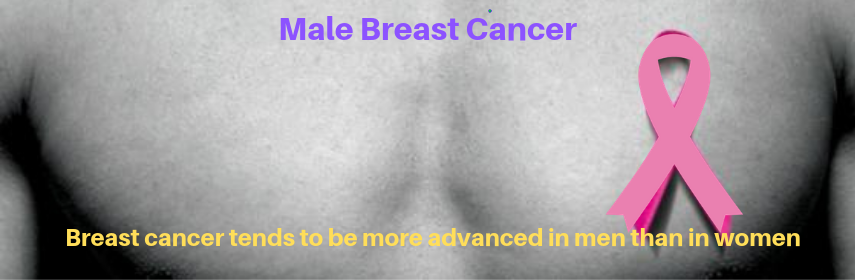
The risks factors for male breast cancer — particularly because men are not routinely screened for the disease and don't think about the possibility that they'll get it. As a result, breast cancer tends to be more advanced in men than in women when it is first detected.
A number of factors can increase a man's risk of getting breast cancer:
A strong family history of breast cancer or genetic mutations: Family history can increase the risk of breast cancer in men — particularly if other men in the family have had breast cancer.
Radiation exposure: If a man has been treated with radiation to the chest, such as for lymphoma, he has an increased risk of developing breast cancer.
some signs to watch for:

Because breast cancer in men is rare, few cases are available to study. Most studies of men with breast cancer are very small. But when a number of these small studies are grouped together, we can learn more from them.
The risks factors for male breast cancer — particularly because men are not routinely screened for the disease and don't think about the possibility that they'll get it. As a result, breast cancer tends to be more advanced in men than in women when it is first detected.
A number of factors can increase a man's risk of getting breast cancer:
- Growing older: This is the biggest factor. Just as is the case for women, risk increases as age increases. The average age of men diagnosed with breast cancer is about 68.
- High estrogen levels: Breast cell growth — both normal and abnormal — is stimulated by the presence of estrogen. Men can have high estrogen levels as a result of:
- taking hormonal medicines
- being overweight, which increases the production of estrogen
- having been exposed to estrogens in the environment
- being heavy users of alcohol, which can limit the liver's ability to regulate blood estrogen levels
- having liver disease, which usually leads to lower levels of androgens (male hormones) and higher levels of estrogen (female hormones). This increases the risk of developing gynecomastia (breast tissue growth that is non-cancerous) as well as breast cancer.
A strong family history of breast cancer or genetic mutations: Family history can increase the risk of breast cancer in men — particularly if other men in the family have had breast cancer.
Radiation exposure: If a man has been treated with radiation to the chest, such as for lymphoma, he has an increased risk of developing breast cancer.
some signs to watch for:
- a lump felt in the breast
- nipple pain
- an inverted nipple
- nipple discharge (clear or bloody)
- sores on the nipple and areola (the small ring of color around the center of the nipple)
- enlarged lymph nodes under the arm
Friday, November 30, 2018
#Rare type of Breast Cancer #Breast cancer Summit 2019
#Inflammatory_Breast_Cancer #Aggressive #Swelling #Spreasd_Quickly #more_common_African_American_women #Also_Affect_men #Redness_breast #Swelling_breast #Warmth #Orange-peel_appearance #Flattening_nipple

Inflammatory breast cancer (IBC) is a rare and aggressive form of breast cancer. According to the American Cancer Society, about 1% of all breast cancer cases in the United States are inflammatory breast cancers.
Inflammatory breast cancer usually starts with the reddening and swelling of the breast instead of a distinct lump. IBC tends to grow and spread quickly, with symptoms worsening within days or even hours. It’s important to recognize symptoms and seek prompt treatment. Although inflammatory breast cancer is a serious diagnosis, keep in mind that treatments today are better at controlling the disease than they used to be.
The average age at diagnosis of inflammatory breast cancer in the United States is 57 for white women and 52 for African American women. These ages are about 5 years younger than the average ages at diagnosis for other forms of breast cancer. According to the American Cancer Society, inflammatory breast cancer is more common in African American women. A 2008 study found that being overweight makes a person more likely to develop IBC. Like other forms of breast cancer, IBC can also affect men.
Common symptoms of IBC include:
Redness of the breast: Redness involving part or all of the breast is a hallmark of inflammatory breast cancer. Sometimes the redness comes and goes.
Swelling of the breast: Part of or all of the breast may be swollen, enlarged, and hard.
Warmth: The breast may feel warm.
Orange-peel appearance: Your breast may swell and start to look like the peel of a navel orange (this is called “peau d’orange”).
Other skin changes: The skin of the breast might look pink or bruised, or you may have what looks like ridges, welts, or hives on your breast.
Swelling of lymph nodes: The lymph nodes under your arm or above the collarbone may be swollen.
Flattening or inversion of the nipple: The nipple may go flat or turn inward.
Aching or burning: Your breast may ache or feel tender.

Inflammatory breast cancer (IBC) is a rare and aggressive form of breast cancer. According to the American Cancer Society, about 1% of all breast cancer cases in the United States are inflammatory breast cancers.
Inflammatory breast cancer usually starts with the reddening and swelling of the breast instead of a distinct lump. IBC tends to grow and spread quickly, with symptoms worsening within days or even hours. It’s important to recognize symptoms and seek prompt treatment. Although inflammatory breast cancer is a serious diagnosis, keep in mind that treatments today are better at controlling the disease than they used to be.
The average age at diagnosis of inflammatory breast cancer in the United States is 57 for white women and 52 for African American women. These ages are about 5 years younger than the average ages at diagnosis for other forms of breast cancer. According to the American Cancer Society, inflammatory breast cancer is more common in African American women. A 2008 study found that being overweight makes a person more likely to develop IBC. Like other forms of breast cancer, IBC can also affect men.
Common symptoms of IBC include:
Redness of the breast: Redness involving part or all of the breast is a hallmark of inflammatory breast cancer. Sometimes the redness comes and goes.
Swelling of the breast: Part of or all of the breast may be swollen, enlarged, and hard.
Warmth: The breast may feel warm.
Orange-peel appearance: Your breast may swell and start to look like the peel of a navel orange (this is called “peau d’orange”).
Other skin changes: The skin of the breast might look pink or bruised, or you may have what looks like ridges, welts, or hives on your breast.
Swelling of lymph nodes: The lymph nodes under your arm or above the collarbone may be swollen.
Flattening or inversion of the nipple: The nipple may go flat or turn inward.
Aching or burning: Your breast may ache or feel tender.
Thursday, November 29, 2018
#Invasive Lobar carcinoma of Breast #Breast Cancer Summit 2019 #Kyoto #Japan
#Breast_cancer #types #Invasive_Lobar_Carcinoma #Infiltrating_Lobar_Carcinoma #swelling #Breast_pain #Nipple_Pain #Skin_irritation #Nipple_Discharge #redness

Invasive lobular carcinoma (ILC), sometimes called infiltrating lobular carcinoma, is the second most common type of breast cancer after invasive ductal carcinoma (cancer that begins in the milk-carrying ducts and spreads beyond it)
“invasive lobular carcinoma” refers to cancer that has broken through the wall of the lobule and begun to invade the tissues of the breast. Over time, invasive lobular carcinoma can spread to the lymph nodes and possibly to other areas of the body.
Although invasive lobular carcinoma can affect women at any age, it is more common as women grow older. According to the American Cancer Society, about two-thirds of women are 55 or older when they are diagnosed with an invasive breast cancer.
Some research has suggested that the use of hormone replacement therapy during and after menopause can increase the risk of ILC.

Invasive lobular carcinoma (ILC), sometimes called infiltrating lobular carcinoma, is the second most common type of breast cancer after invasive ductal carcinoma (cancer that begins in the milk-carrying ducts and spreads beyond it)
“invasive lobular carcinoma” refers to cancer that has broken through the wall of the lobule and begun to invade the tissues of the breast. Over time, invasive lobular carcinoma can spread to the lymph nodes and possibly to other areas of the body.
Although invasive lobular carcinoma can affect women at any age, it is more common as women grow older. According to the American Cancer Society, about two-thirds of women are 55 or older when they are diagnosed with an invasive breast cancer.
Some research has suggested that the use of hormone replacement therapy during and after menopause can increase the risk of ILC.
Subscribe to:
Posts (Atom)
Final Call for Speakers @breastcancersummit2019
Last Call for participating at the event 9th World Congress on Breast Cancer & Therapies (Breast Cancer Summit 2019) #April 29-30, 2...
-
9th World Congress on Breast Cancer & Therapies (Breast Cancer Summit 2019) #april 20-30, 2019 # kyoto, Japan 2nd Cycle of Early B...
-
Last Call for participating at the event 9th World Congress on Breast Cancer & Therapies (Breast Cancer Summit 2019) #April 29-30, 2...
-
How destroying a tumor promoter could lead to new cancer treatments Scientists have cracked a cell mechanism that drives tumor...